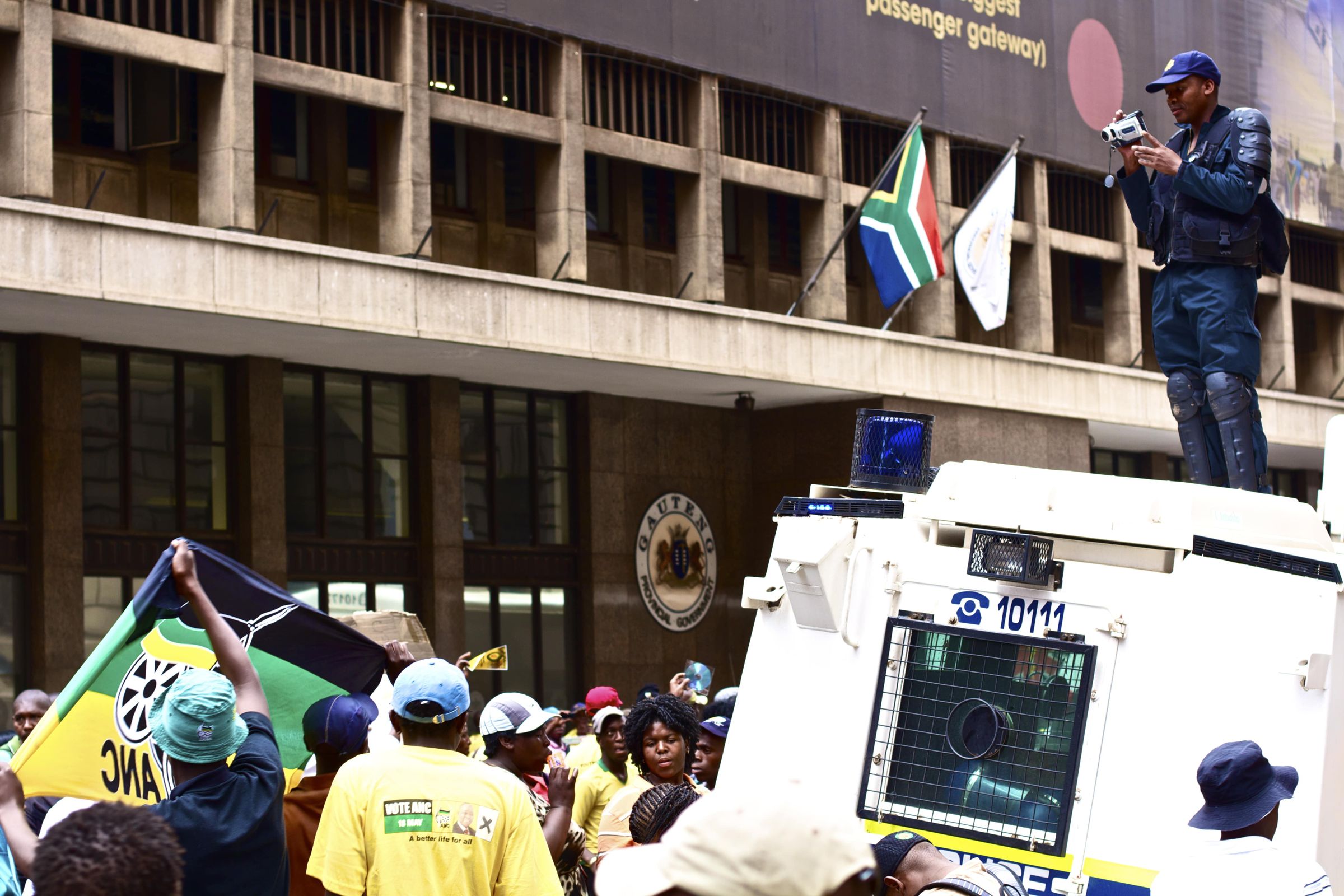
With just over two weeks to go before the 4 November local government elections, voters are telling President Cyril Ramaphosa plainly what they think. “Many South Africans are deeply frustrated by the state of local government,” he said, citing electricity disruptions, deteriorating roads and water failures. “A mother opens a tap and there is no water… People have spoken to us with great frankness. People say, ‘We expect much more from you.’”
He was speaking with editors and journalists in Johannesburg on Monday, 19 October, at a Black Wednesday event marking the 1977 apartheid crackdown on black resistance publications, organisations and people. The ANC president acknowledged the anger on the campaign trail. In KwaZulu-Natal, he recounted, pensioners and children thanked him for social grants while unemployed young people demanded work. “The young people say, ‘We want jobs. You have educated us.’”
His answer to that frustration is the same national reform programme he returned to repeatedly when confronted with economic and municipal failures. But he urged the party not to read the mood as rejection. “We should not mistake disappointment for hostility. Those who criticise most have invested the most hope in our movement.”
That tension between immediate municipal collapse and long-promised reform ran through the entire briefing, and Ramaphosa illustrated with unusual frankness how he tries to force the state to respond. He revealed that he personally warned Johannesburg Mayor Dada Morero to clean up the city ahead of the G20 Leaders’ Summit, held in Johannesburg on 22 and 23 November 2025, or risk losing his job.
“As we were going to the G20, I drove around the streets, and I called the mayor,” he recalled. “Do you expect them to come to a Joburg as filthy as this? If you value your job, start cleaning up.” According to Ramaphosa, Morero immediately stepped up the clean-up campaign in the city, whose deteriorating infrastructure and failing services have become major election issues. Morero had earlier led a six-week inner-city clean-up operation in February 2025, followed by a campaign to rehabilitate illegal dumping sites in June.
It was a political ultimatum rather than a formal threat of dismissal, and it was not the only one. Ramaphosa described delivering a similar warning in Mangaung after encountering filthy streets there, demanding action and promising to return within a week; cleaning equipment appeared the following day. On another occasion, he said, “I landed at an air force base some time ago and I said, ‘These weeds must be gone when I come back.’” When he returned, the weeds had been removed.
On Johannesburg’s mayoral candidacy, Ramaphosa defended the ANC’s selection process, saying the party had opened up the choice of mayoral candidates. “It is by no means only Dada Morero who should be able to tell you the story of Johannesburg.” The party has shortlisted Morero, regional chairperson Loyiso Masuku and the Rev Frank Chikane, though Chikane was subsequently absent from the ANC’s certified Electoral Commission (IEC) candidate list.
Meanwhile, for households feeling the squeeze at the pump, Ramaphosa hinted at relief. “It’s a matter we are giving consideration to,” he said of measures to cushion South Africans against soaring fuel prices. He put the cost of previous interventions at approximately R24-billion, saying money had been diverted from other programmes. The National Treasury estimated that temporary fuel levy reductions between April and June 2026 cost R17.2-billion in foregone tax revenue, while a four-month relief package in 2022 cost R10.5-billion. Parliament’s Standing Committee on Appropriations has approved a report on a proposed R10-billion fuel stabilisation allocation to the Department of Mineral and Petroleum Resources, funded through the National Revenue Fund, though the Bill still requires parliamentary approval. Ramaphosa also cited a R5-billion contingency reserve as evidence of limited fiscal room. The timing matters: Finance Minister Enoch Godongwana delivers the Medium-Term Budget Policy Statement on Wednesday, 21 October.
On trade, Ramaphosa issued one of his clearest warnings yet that South Africa could lose its African Growth and Opportunity Act (Agoa) benefits with the United States, with the current extension expiring on 31 December. “We are not the first and only country to be taken out of Agoa and will not be the last,” he said, acknowledging the loss “will be devastating” for exporters, particularly in motor manufacturing and agriculture, and threatening jobs. He and Deputy President Paul Mashatile have travelled internationally to explore alternative markets, including trade opportunities with China.
Defending the pace of reform, Ramaphosa pointed to IMF forecasts of just 1% growth in 2026, down from 1.4% at the start of the year, and insisted rebuilding institutions damaged by State Capture, including Eskom, the South African Revenue Service and the rail network, must come first. Passenger rail offered his proof: Prasa recorded more than 100 million passenger journeys in the financial year ending March 2026, up from about 77 million the previous year, though those are journeys rather than individual commuters. He also spoke of ambitions to expand early childhood development from about two million children to seven million, and said in a separate address that more than 1.6 million children attend registered early learning programmes, with universal access targeted by 2030.
Closing on the anniversary that framed the event, Ramaphosa defended media freedom, recalling that The World and Weekend World newspapers were banned in 1977 and editor Percy Qoboza and deputy editor Aggrey Klaaste were detained. “A free press is one that has the freedom to question the government and expose its failures. That is the nature of democracy.” He warned that disinformation can undermine public confidence, citing a fabricated image showing him and Mashatile in hospital beds that many believed was genuine, and announced plans to lead a delegation to Silicon Valley after the elections to engage technology companies on artificial intelligence. “That is why credible and professional journalism is more important than ever before.”